Dembéni Centre-East Middle School
Full Architectural and Engineering Design Services
Winner of the design competition, 2023 – Studies in progress
Environmental approach
Low-carbon and bio-based design / Water resource management / Energy autonomy / Sustainable facilities / Bioclimatic site planning / Photovoltaic panels / Solar thermal installation
Areas
6,370 m² net usable area
4,235 m² outdoor spaces
1,010 occupants
– 900 students (30 classes of 30 students)
– 30 administrative staff
– 60 teaching staff
– 20 maintenance and catering staff
Client (MOA)
Académie de Mayotte
Project management assistance (AMO): ALGOE
Design Team (MOE)
Architects: Carta – Reichen et Robert Associés, lead consultant
Atelier Mahorais d’Architecture, co-consultant
Engineering (BET): Egis Bâtiments Océan Indien
Acoustics: ACOUSTB
Collective catering consultancy: CORAIL
Security studies: ALTHING SAS
Landscape designer: JNC International Agence Sud
Credits
Visualizations: Les Yeux Carrés
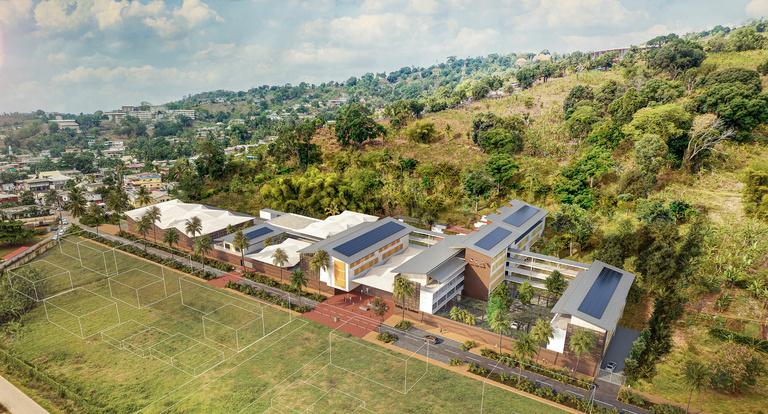
The Dembéni Middle School project in Mayotte is set within an atypical urban and geographical context. Designed to accommodate 900 students, the school embodies an ambitious architectural and landscape response tailored to its environment. Built on a hillside, it ensures a transition between the historic village and a future planned development zone (ZAC), symbolizing the link between tradition and modernity.
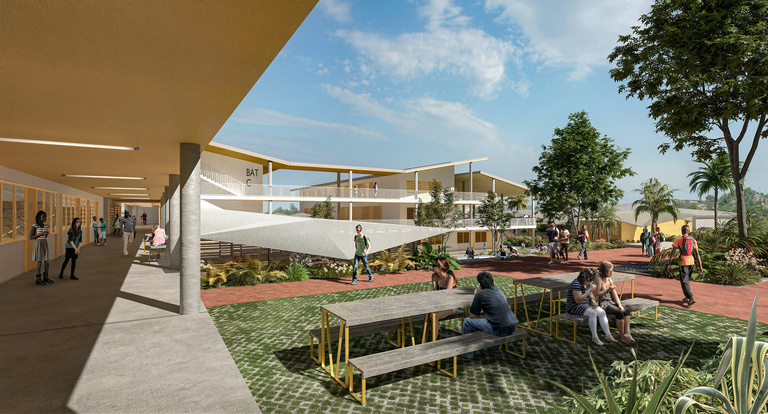
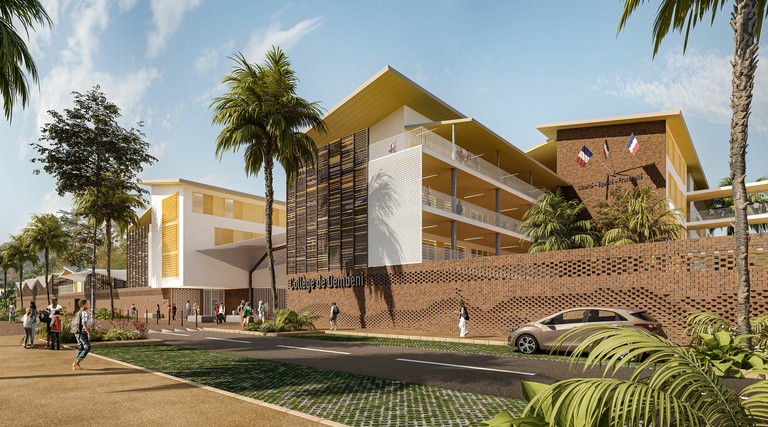
The school adopts a morphology inspired by a “citadel,” combining protection, openness, and radiance. Its fragmented and rhythmic structure incorporates R+3 “comb-like” built forms that limit exposure to noise pollution while maximizing natural ventilation. These volumes are connected by generously shaded walkways, promoting fluid circulation and façades protected from climatic hazards.
The project’s flagship material is locally sourced compressed earth brick, both bio-based and geo-sourced, which clads the urban base. This material embodies Mahoran identity while ensuring exemplary environmental performance.
The design enhances the landscape by preserving natural gullies, existing vegetation, and creating green corridors that improve the quality of outdoor spaces. Particular attention is given to climatic management and seismic risks, with architecture adapted to the island’s hot and humid climate.
Passive strategies, such as capturing the trade winds and providing natural shading, ensure optimal thermal comfort. The sustainable approach is further reflected in the flexibility of the spaces, allowing for future extensions without disrupting the school’s initial operation.
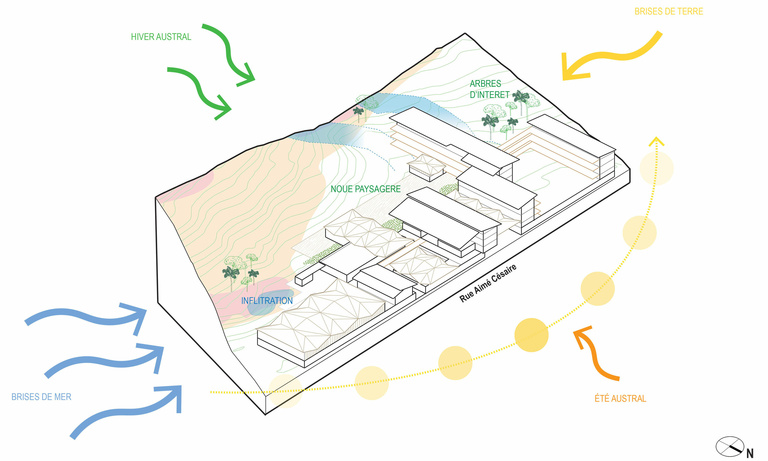
Le Collège de Dembeni : une passerelle urbaine au cœur d’un paysage en mutation